Creating Patterns
Designer patterns are bitmap image files, also called .bmp files. Since Designer is compatible with most bitmap files, you can create patterns using many different image editing programs.
You do not need to be a professional designer to make patterns. Simple stripes, gradients, dots, and repeating shapes can create beautiful effects when your prop is spinning.
Image Editors
You can use almost any image editor that can save files as .bmp.
If you do not already have an image editor on your computer, here are a few options:
- Pixlr: A free browser-based editor that works online without installing software.
- GIMP: Free, open-source, and fully featured.
- Adobe Photoshop: Paid professional image editing software.
- Microsoft Paint: A simple built-in option on many Windows computers that can be useful for very basic edits and pixel-level work.
For many beginners, Pixlr or Microsoft Paint may be easier places to start. GIMP and Photoshop offer more control, but they also have more tools to learn.
How Designer Reads a Pattern
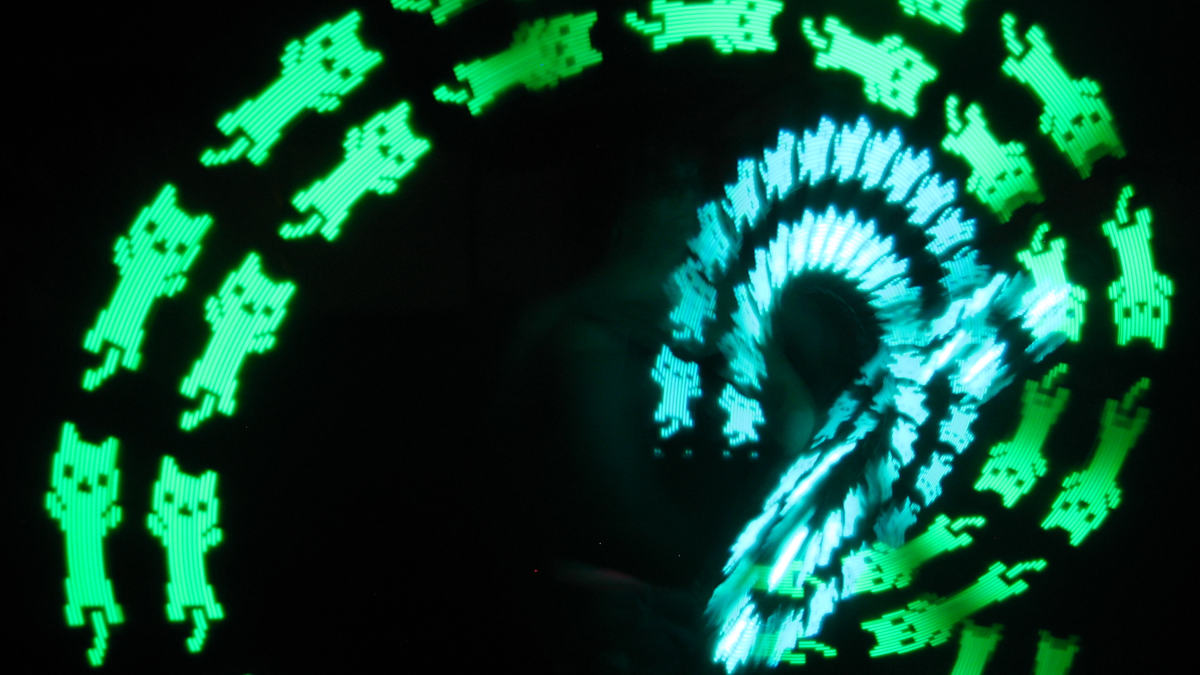
Designer reads bitmap images one row at a time, moving from the top of the image to the bottom. When it reaches the bottom, it loops back to the top and continues.
When the prop spins, these rows of pixels become the light trails you see in motion.
This means that even a simple image can become much more interesting once it is displayed on a moving LED prop.
Pattern-Making Tips
The width of your bitmap affects how the pattern appears on your prop.
- If the width of a .bmp file is greater than the number of LEDs in your prop, the extra width will be ignored.
- If the width of a .bmp file is less than the number of LEDs in your prop, the image will repeat.
If you are using a high-resolution image, you will usually need to scale it down quite a bit before using it as a Designer pattern.
Using Black Backgrounds
Black pixels do not require the LEDs to turn on. Because of this, patterns with more black space may use less battery power than patterns with bright full-color backgrounds.
Black backgrounds can also make bright details stand out more clearly while spinning.
Creating Recognizable Images
If you are trying to display a recognizable image on a hoop, such as a simple logo or symbol, you may need to resize it smaller than you expect.
For hoops, a good starting point is to make the image width about one third of the hoop’s LED count.
This is because someone watching you hoop usually sees only part of the hoop clearly at one time.
Color Depth
You may have heard the term “8-bit” in reference to retro video game graphics. When working with bitmap files, color depth refers to the maximum number of colors that can be included in the image.
Your image editor may save bitmap files as 24-bit by default, which supports millions of colors.
Designer is compatible with:
- 24-bit bitmaps
- 8-bit bitmaps
- 4-bit bitmaps
Designer currently does not support 16-bit bitmaps.
For most users, 24-bit bitmap files are the easiest and most reliable choice.
Beginner Pattern Ideas
If you are new to creating patterns, try starting with simple designs such as:
- Diagonal stripes
- Vertical gradients
- Dots on a black background
- Simple geometric shapes
- Repeating color blocks
Simple patterns often look much more complex once they are spinning.
Want to Try a Simple Pattern Project?
Chaser patterns are a great place to start because they can be made from a very simple diagonal line.
To learn how to make one, visit the Creating Chaser Patterns section.